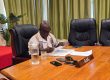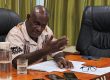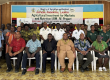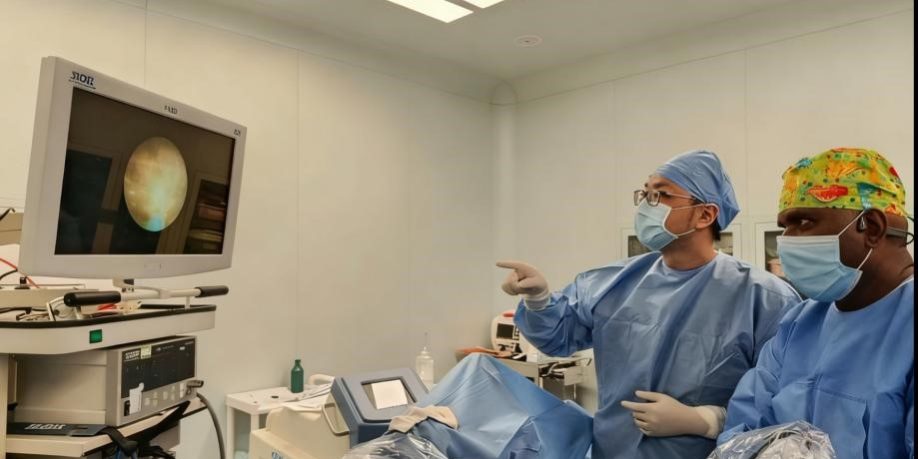
Recently, the 4th China Medical Team, in collaboration with the Urology Department of the National Referral Hospital (NRH), successfully performed holmium laser ureteroscopic lithotripsy for a patient with acute renal failure, followed by the placement of double-J stents.
This marks the first ureteroscopic intraluminal lithotripsy in the country’s history and signifies the beginning of a new era of minimally invasive urologic surgery in Solomon Islands.
The patient, a 49-year-old male, was admitted with acute renal failure, presenting a creatinine level of 969 μmol/L and life-threatening hyperkalemia. Imaging revealed ureteral stones with severe hydronephrosis.
After emergent medical treatment stabilized his metabolic status, Dr. Chen Xulong from the China Medical Team and NRH surgeon Dr. Augustine Melly proceeded with the operation following a thorough risk assessment.
To ensure patient safety, the team adopted a staged treatment strategy. During this procedure, they first addressed the more severely obstructed ureter, performing laser lithotripsy and simultaneously placing double-J stents to facilitate a planned second-stage lithotripsy on the remaining side. The entire procedure was completed without any incisions, fully achieving minimally invasive surgery.
Throughout the operation, Dr. Chen provided detailed demonstrations and technical explanations on key steps including ureteroscope entry, management of narrow segments, mucosal protection, precise stone localization, endoscopic lithotripsy techniques, and holmium laser parameter control.
Notably, Dr. Augustine Melly previously received three months of training under the “China–Solomon Islands Minimally Invasive Urologic Surgery Center Program” at the Affiliated Hospital of Guizhou Medical University.
During this operation, he skillfully applied his newly acquired endoscopic techniques and standardized procedural knowledge, working seamlessly with Dr. Chen to ensure efficient and smooth completion of the surgery.
This milestone highlights a transition from “training in classrooms” to “hands-on clinical practice” in China–Solomon Islands medical cooperation.
Postoperatively, the patient recovered well. His creatinine level gradually improved to 185 μmol/L, serum potassium normalized to 3.8 mmol/L, and all symptoms improved significantly. He has since been discharged in good condition.
According to Dr. Zhao Xueke, leader of the 4th China Medical Team, the success of this surgery was greatly supported by the modern holmium laser lithotripsy equipment provided through the “China–Solomon Islands Minimally Invasive Urologic Surgery Center Program”.
This technology fills a major technical gap in Ureteroscopic Lithotripsy in Solomon Islands, allowing ureteral stones to be treated without open surgery, significantly reducing trauma and complications while enabling patients to access internationally advanced, minimally invasive care. Beyond saving a critically ill patient, this procedure marks the beginning of a new chapter in developing a local minimally invasive urology team.
Looking ahead, China and Solomon Islands will continue deepening collaboration, gradually expanding the use of endoscopy, holmium laser, and other minimally invasive techniques to provide safer, faster-recovery, and less-invasive treatment options for more local patients.
- MHMS