Residents and villagers of Wagina Island in Choiseul Province have reaffirmed their firm opposition to proposed bauxite mining.
This followed another consultation meeting involving government representatives, land lawyers and the proposed mining company.
Speaking to Solomon Star this week, Wagina resident and seaweed farmer Para Tokananipiri said nearly 100 per cent of the island’s population continues to reject any form of mining activity.
He said the most recent consultation meeting was held in November last year and was attended by landowners, community members, government officials, lawyers and representatives of Solomon Bauxite Limited (SBL).
“Almost every landowner and resident on Wagina Island attended that meeting, and the message was clear, the people do not want mining,” Mr Tokananipiri said.
He stressed that despite repeated engagements with authorities over the years, the community’s position has remained unchanged.
“Although the government has power, our cry has always been the same — no mining on our island,” he said.
Mr Tokananipiri explained that the Micronesian community living on Wagina Island relies heavily on the sea and marine resources for survival.
“If mining happens on Wagina Island, our people will suffer for the rest of their lives,” he said.
He added that the island is known for its rich marine resources, which form the backbone of local livelihoods, food security and small-scale economic activities such as fishing and seaweed farming.
“When the government representatives, lawyers and the proposed mining company came in November last year, they were not welcomed by the community.
“As a result, there was no positive report they could take back after the meeting,” he added.
Other sources said that Sam Ling Sun Company was amongst those that raised interest in mining during the recent visit to Wagina Island.
The mining dispute on Wagina dates back to 2013, when Solomon Bauxite Limited — linked to South West Pacific Bauxite interests — received government approval to develop an open-pit bauxite mine on the island.
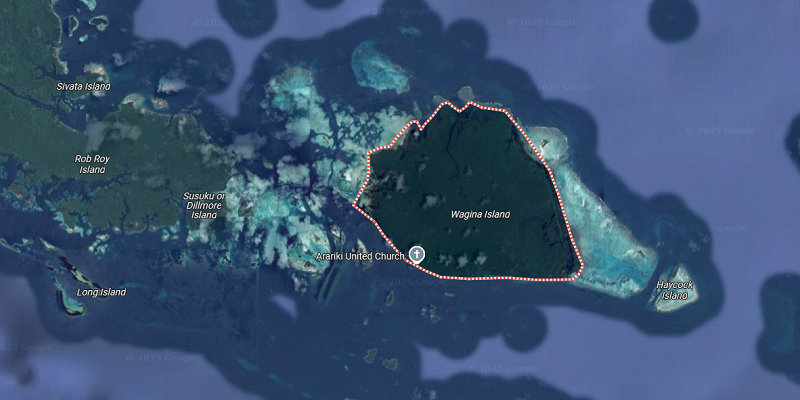
According to the Environmental Defense Office (EDO), the proposal would have affected approximately 48 square kilometres, or nearly 60 per cent of the island’s total land area, requiring large-scale forest clearance and long-term excavation.
Wagina Island covers just 78 square kilometres, and residents argued that the project would cause irreversible damage to land, rivers and surrounding marine environments.

The island’s roughly 3,000 residents have been engaged in a legal battle against the mining project for more than seven years, first taking the company to court in 2014.
Reports indicate that the Environmental Advisory Committee (EAC) later revoked the development consent granted by the Ministry of Environment, citing the company’s failure to obtain proper community consent and to provide residents with copies of the Environmental Impact Statement (EIS).
While Solomon Bauxite Limited still holds a mining lease, the company would be required to reapply for development consent before any mining could proceed.
According to the EIS, the proposed project included an open-pit mine, wharves, an airstrip, power station, fuel storage facilities and accommodation for up to 150 workers, with the population potentially increasing to 1,000 people including family members.
The proposal also involved trucking up to 150 loads of bauxite daily over a period of 16 to 20 years.
Media reports further indicated that the former Premier of Choiseul Province, Tongoua Tabe, was removed from office through a motion of no confidence in March 2024, a move widely linked to his firm opposition to mining in the province.
Reports said the motion, passed on March 7–8, accused Mr Tabe of failing to act in the interests of the provincial government by declining to engage with foreign investors pursuing mining and logging projects.
Mr Tabe later attributed his removal to his strong stance against mining, particularly his opposition to the Siruka project and the proposed bauxite mining on Wagina Island.
He noted that he had survived an earlier no-confidence motion in January 2024 on similar grounds.
Following his removal, Harrison Pitakaka was elected as the new Premier of Choiseul Province later in March.
Mr Tabe has since been quoted as saying that Choiseul Province is not ready for mining, citing weak mining laws that he said fail to adequately protect landowners, provincial governments and the environment.
Meanwhile, Leader of Opposition Hon. Matthew Wale has strongly urged the government to suspend and halt all mining licences until a proper and comprehensive mining policy is established.
Speaking during a Public Accounts Committee (PAC) hearing in November last year, Mr Wale said the government must stop issuing new licences, close existing ones where necessary, and reassess how the mining sector is managed in the best interest of the country.
He warned that the government has shown weakness in overseeing mining operations, allowing companies to manipulate the system while Solomon Islands continues to lose out on its own resources.
Mr Wale said there is an urgent need for serious policy reform, cautioning that unless the government takes firm control of the sector, the country risks repeating — and worsening — the failures experienced in the logging industry.
He also raised concerns over the current Minerals Bill, noting that while it contains some positive intentions, it includes serious flaws, particularly Clause 49, which restricts government involvement.
For coastal communities like Wagina, residents say the issue goes beyond environmental protection, touching on land rights, cultural survival and historical injustices linked to the colonial-era resettlement of their ancestors from Kiribati in the late 1950s.
As government interest in mining continues, Wagina Islanders maintain that their position remains unchanged: no mining on their island.
By ULUTAH GINA
Solomon Star, Gizo