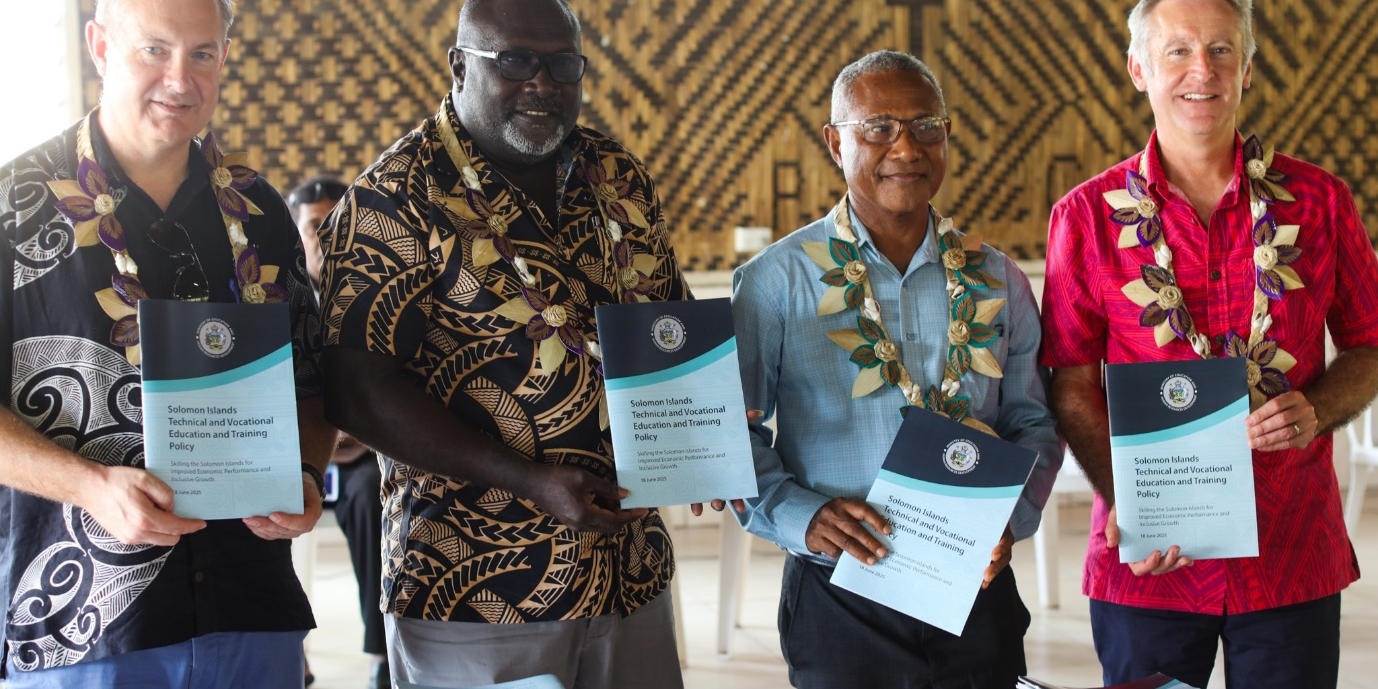
The Ministry of Education and Human Resources Development (MEHRD) officially launched the long-awaited Technical and Vocational Education and Training (TVET) Policy on Friday, February 5, 2026, marking a significant milestone aimed at transforming the education sector through technical and vocational skills to increase national productivity.
The new policy is a unifying framework for all TVET providers across the country, marking a turning point in the nation’s efforts to deliver high-quality skills training and create meaningful career pathways for young Solomon Islanders.
In launching the policy, the Minister of Education and Human Resources Development, Hon Tozen Leokana, highlighted the policy’s significance in reshaping the national education landscape.
“This national TVET policy is not just an adjustment at the urge of our education system, but it’s a structural reform”, Minister Leokana said.
He acknowledges the development partners for their continuous support and collaboration, emphasising MEHRD’s commitment to the TVET policy.
“We are positioning TVET as a cultural or central pillar of economic reform, workforce planning, and national self-reliance -Not as an afterthought to academic education,” he said.
Also speaking at the ceremony was the Australian High Commissioner, His Excellency Jeff Roach, commending the Solomon Islands Government for its leadership and vision.

“This TVET Policy will strengthen the quality and relevance of vocational education. I want to acknowledge the Minister for your strong support towards TVET in Solomon Islands and its vision for the future,” His Excellency Jeff said.
Australia has long been a development partner in education, including support to TVET institutions and training programs.
The New Zealand High Commissioner, His Excellency Jonathan Andrew Curr, also expressed congratulations and reaffirmed New Zealand’s partnership and support in the TVET sector.
“Policy provides a crucial framework, and of course, it’s only the beginning. TVET system that’s robust, effective, and delivers for Solomon islanders requires a sustained collective effort,” His Excellency Jonathan said.
With this policy now in place, all TVET providers in the country will follow one national system that helps improve training quality and address the long-standing issue of students leaving school early.
The policy aims to develop productive citizens by equipping them with the technical and vocational skills to contribute to national development and economic transformation.
– MEHRD
Lead Photo Caption; From left: Australia High Commissioner His Excellency Jeff Roach, Minister of Education Hon. Tozen Leokana, Permanent Secretary Dr. Franco Rodie, and New Zealand High Commissioner His Excellency Jonathan Andrew Curr displaying the copy of the TVET Policy.