WING Leader of the Solomon Islands United Party (SIUP), Peter Kenilorea Jr, has emphasized that numbers remain the foundation of democracy, rejecting claims that the new coalition’s strength is merely a “snapshot.”
His comments follow statements by Prime Minister Jeremiah Manele and Attorney General John Muria Jr, who downplayed the opposition coalition’s claimed 28 Members of Parliament (MPs).
The new coalition comprises the Peoples First Party (PFP), Solomon Islands Democratic Party (SIDP), United Party (UP), Solomon Islands Party for Rural Advancement (SIPRA), Democratic Alliance Party (DAP), and the Umi for Change (U4C) Party.
The group has formalized its alliance under the Political Parties Integrity Act (PPIA).
This development came after PFP withdrew from the Government for National Unity and Transformation, which included the OUR Party and Kadere Party.
The withdrawal was made under Section 54 (3) and (4) of the PPIA, meaning the usual 30-day notice requirement does not apply, as the majority of PFP MPs agreed to rescind the coalition agreement.
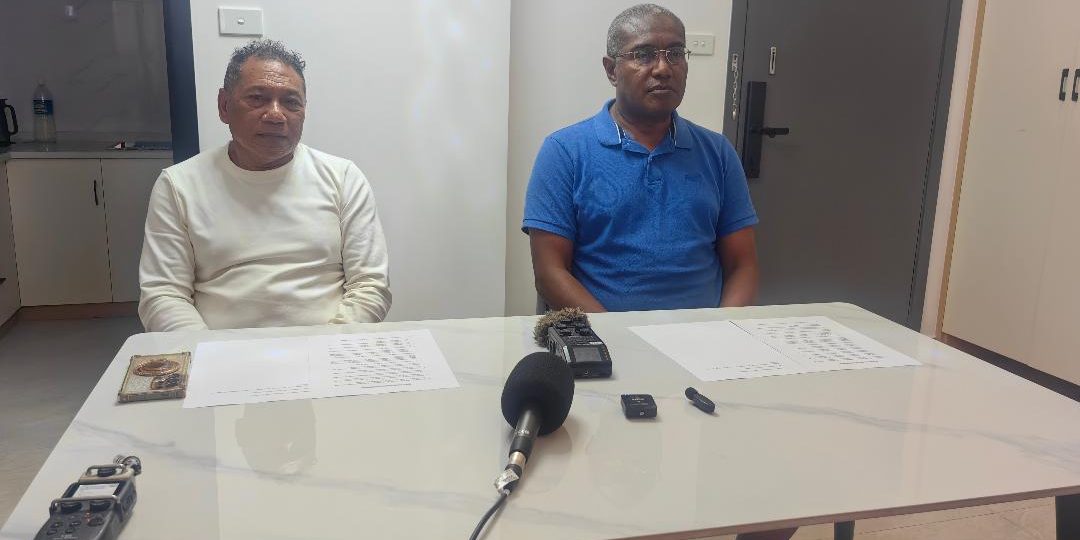
Speaking at a press conference on Monday, Kenilorea said the issue at hand concerns the political government, not the public service.
“We are talking here about the political government — those elected by the people to govern. That is what we are trying to fix,” he said.
He stressed that democratic legitimacy is determined by numbers, beginning from the electoral process.
“When you come through elections under the first-past-the-post system, it is about numbers. The one with the highest number wins,” he said.
Kenilorea rejected suggestions that numbers are merely theoretical.
“Number is not a concept. Number is what makes politics operate. It is what gives Members of Parliament and the Prime Minister legitimacy,” he said.
He added that the Prime Minister’s authority depends on commanding an absolute majority in Parliament.
“When there is talk that numbers are not important, we completely reject that. Numbers are the foundation of democracy,” he said.
Kenilorea also pointed to what he described as signs of a minority government, including difficulties in filling Cabinet positions and reliance on acting ministers.
“That in itself is confirmation that the government is operating as a minority,” he said.
He warned that prolonging the situation undermines democratic governance.
“Each day this continues is an insult to our democratic system,” he said.
Kenilorea called on Prime Minister Manele to either resign or allow Parliament to determine the government’s legitimacy.
“If you don’t want to resign, take it to Parliament and let Parliament decide,” he said.
“For us, it is clear that the Prime Minister has lost the confidence of Parliament.”
Meanwhile, former Foreign Affairs Minister and MP for Central Guadalcanal, Peter Shanel Agovaka, echoed similar sentiments.
He said the PPIA itself demonstrates that the Prime Minister no longer has the numbers and urged him to convene Parliament.
“I call on the Prime Minister to think about the nation and allow Parliament to test his numbers,” Agovaka said.
He noted that unlike the era of former Prime Minister Bartholomew Ulufa’alu, the current political environment is governed by the PPIA.
Agovaka stressed that the principle of numbers must take precedence in a democracy.
“A vote of no confidence is the most important motion in Parliament. It takes precedence over all other business,” he said.
He added that Parliament must be convened to deliberate on the motion of no confidence.