Delays in hearing attributed to glitches at the High Court’s electronic filing system
By ASSUMPTA BUCHANAN
Solomon Star, Honiara
The High Court will resume on Friday for full hearings into the constitutional case between the New Coalition and the Government for National Unity and Transformation (GNUT), following delays caused by issues in the court’s electronic filing system.
Chief Justice Sir Albert Palmer on Wednesday directed all parties to submit required documents by close of business, paving the way for hearings on both the strike-out application and the substantive constitutional claim.
The matter, fast-tracked due to its national significance, centres on the legal authority to convene Parliament amid ongoing political uncertainty over majority support in the House.
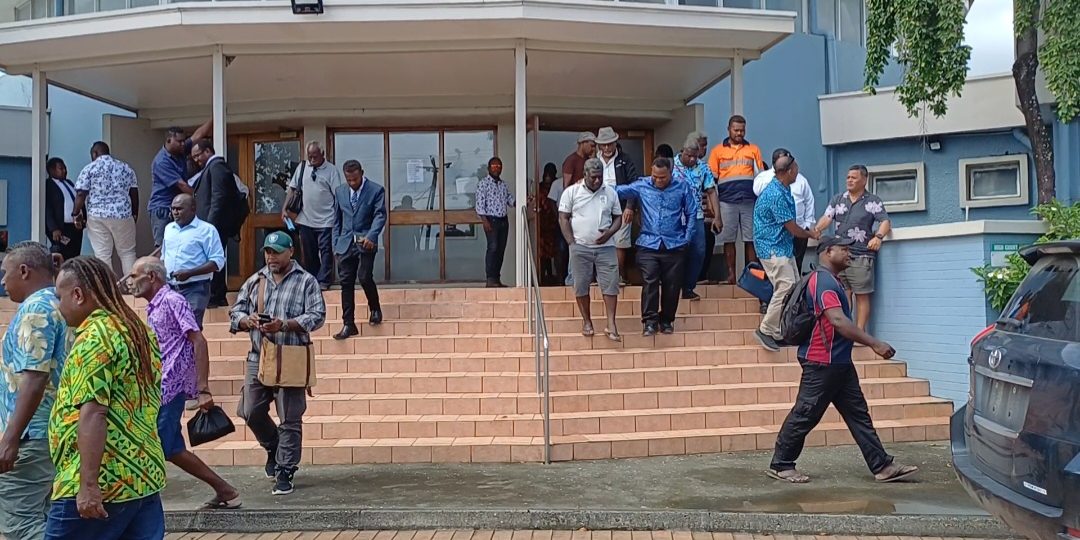
Counsel for the claimants, Gabriel Suri, outside of court said the hearing was initially scheduled to proceed on Wednesday but had to be vacated because sworn statements and submissions were delayed.
He attributed the delays to glitches in the High Court’s electronic filing system, known as JIMS (Justice Information Management System), which affected both parties.
“Some submissions came late, and some sworn statements came late due to problems with the electronic system,” Suri said.
He confirmed that some documents, including submissions from the Attorney General’s Chambers, were only received on the day of the scheduled hearing.
As a result, he requested that the hearing be vacated to allow additional time for preparation.
Thursday has been set aside for final preparations, with the matter now scheduled to proceed on Friday. “No more filing… Friday we will definitely proceed,” Suri said.
He added that the Court has opted to bypass the usual pre-trial stage to expedite proceedings, noting that a pre-trial conference had already been conducted earlier.
Friday’s hearing will address both the strike-out application filed by Attorney General John Muria Jr and the substantive claim brought by the New Coalition.
Suri said the core of the claim is to determine the constitutional powers of the Governor-General in setting the date and time for convening Parliament.
He outlined three main arguments to be advanced: that the Governor-General have expressed power but did not want to use, and instead passed it on to the Prime Minister.
“The other two are, implied power and reserve power,” Suri added.
He noted that the Attorney General has applied to strike out the case, arguing that these issues are purely political and not for the Court to decide.
“We disagree with those arguments. While the matter arises from a political platform, there are legal disputes that the High Court has the jurisdiction to resolve,” Suri said.
Meanwhile, Attorney General Muria said the Government was ready to proceed with the hearing and supported continuing the matter due to its urgency.
“They said the matter is urgent. If it is urgent, then we should proceed,” he said.
Muria acknowledged the filing issues but said they should not prevent the case from moving forward, describing some outstanding documents as additional.
He reiterated that the strike-out application was filed on the basis that the case discloses no reasonable cause of action and that proper legal procedures were not followed.
Regarding the amended application, Muria said it primarily involved changes to factual matters, with legal arguments largely unchanged.
He also defended the earlier application for security for costs, explaining it was intended to manage litigation risk and ensure costs could be recovered if the Government is successful.
The High Court had previously dismissed both the security for costs application and a separate attempt by the Kadere Party to join the proceedings, allowing the case to proceed.
The case was filed by a coalition of 28 Members of Parliament, led by Frederick Kologeto, Matthew Wale, and Manasseh Maelanga, along with several political parties.
The group is challenging the Government’s authority in relation to convening Parliament, following recent political developments that raised questions about majority support in the House.
The defendants are the Governor-General, the Prime Minister, the Speaker of Parliament, and the Attorney General, represented by John Muria Jr.