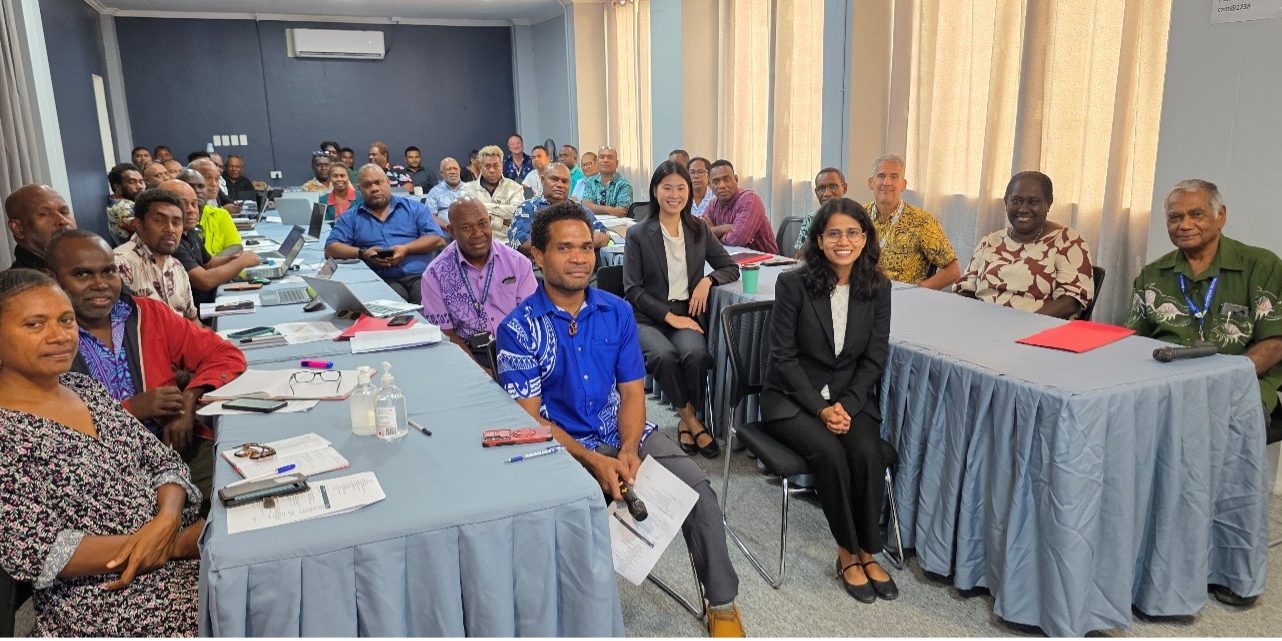
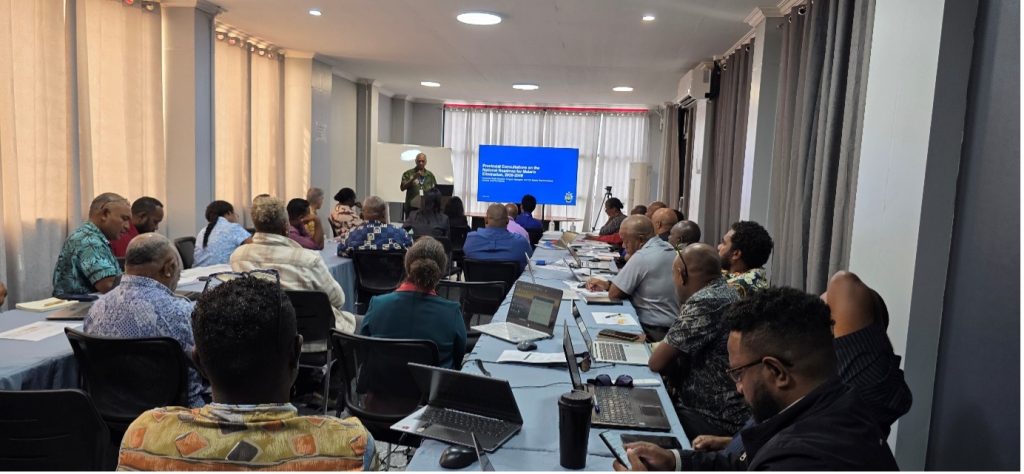
The Ministry of Health and Medical Services (MHMS) Vector Borne Disease Program with support from the Prime Minister’s Office, the Global Fund/World Vision, World Health Organization (WHO) and the Asia Pacific Leaders Malaria Alliance (APLMA), today (25th March) completed a three‑day consultation workshop to advance the National Roadmap for Malaria Elimination 2026–2040.
The workshop brought together Health Provincial Directors, Malaria Program Managers and Technical Partners to review the draft roadmap, tailor interventions to provincial contexts, and strengthen coordination between national and subnational stakeholders. The roadmap sets out strategic efforts to achieve a malaria‑free Solomon Islands by 2040.
Objectives of the workshop:
• Present the draft National Roadmap for review and input.
• Tailor provincial interventions based on malaria burden by constituency.
• Identify resources, capacity gaps, and technical support needs for implementation.
• Map governance mechanisms and roles at provincial level.
• Strengthen coordination and accountability pathways between national and subnational stakeholders.
Mrs. Pauline McNeil, Ministry’s Permanent Secretary noted malaria remains one of SI greatest public health challenges.
“The reality is sobering; cases have quadrupled over the past decade. This is not just statistic; it represents a massive strain on our families, our workforce, and our provincial health systems. It is clear that we cannot continue as we have been.
“While we may have lost some earlier momentum, we now have a powerful new catalyst. Prime Minister Manele has taken a deep personal interest in this agenda, elevating malaria elimination to a top-tier national priority. We are here to harness this high-level political motivation.
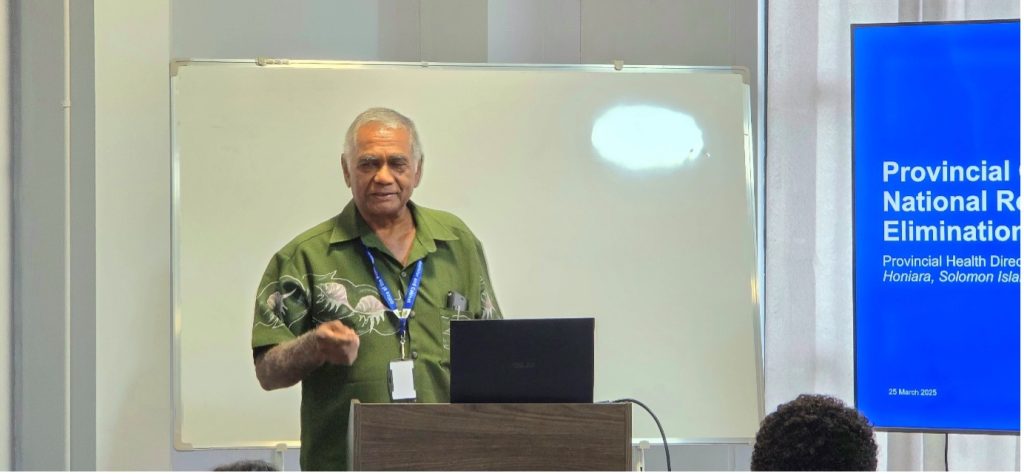
“The OPMC is fully behind this agenda, and they are looking to us—the technical experts—to provide the Roadmap that will guide the nation. This is our opportunity to ensure our technical expertise shapes the national priority”, said Mrs. McNeil.
She commended the participants for their intensive discussions held over the past two days.
“Today, we build on that. We will share the updated National Malaria Elimination Roadmap, detailing specific interventions designed to tackle both high-burden areas and low/elimination zones. We will look closely at our DHIS2 data and core monitoring indicators. These metrics ensure we stay on track and remain accountable to the people we serve. 4
“To ensure this Roadmap is ready for implementation, our work today focuses on: 1. Review & Input: Presenting the draft National Roadmap for your expert provincial review. 2. Resource Mapping: Identifying capacity gaps and the operational resources needed for provincial implementation. 3. Governance: Defining clear roles and responsibilities at the provincial and constituency levels.
PS McNeil calls on all PHDs to use this Roadmap as the primary guide for their Annual Operational Plans (AOPs). It will be fully costed, and we will need disciplined and coordinated funding efforts to resource it.
She revealed the M&E indicators shared will be reported to OPMC. She called on respective participants to take accountability for this data being updated and address any inaccuracies promptly.
Describing the roadmap is only as strong as the data behind it.
“To reach elimination, we need a fast response at every level. I am looking to you—the PHDs—to monitor these needs closely. You must ensure that resources—whether funds or human resources—are available and ready to respond to needs on the ground as they arise. Effective case management cannot rest on the malaria team alone.
“We must strengthen our alignment with all health teams, our nurses, and our public health workers at the provincial and facility level—they are on the front line, and their consistent adherence to protocols and clinical guidelines is essential to our success.
“What is also of equal importance is to ensure we are connected to the communities that we serve – to our elders, chiefs, church leaders, men, women, girls and boys so that we get their buy-ins along the process. It is for them that we are doing, for our people”, said Mrs. McNeil.
She acknowledged the Asia Pacific Leaders Malaria Alliance for their invaluable partnership in drafting this roadmap and aligning SI with regional best practices.
Thanked the National Vector Borne Disease Control Programme (NVBDCP) for their continued technical leadership, their expertise is the engine of this national response. Thanked the PHDs and Provincial Managers, they turn these plans into protection SI citizens.
“The goal is ambitious, but with the Prime Minister’s backing and your unwavering dedication, it is achievable”, said Mrs. McNeil.
Dr. Jimmie Rodgers Special Duty Secretary to Prime Minister said malaria is a development issues, an economic issue, and an educational issue. It requires every sector of our society to play its part.
He noted, malaria elimination has evolved beyond a health sector goal. In countries that have successfully eliminated malaria, the measures involved whole of government and whole of society partnership and interventions.
“In Solomon Islands, the Ministry of Health has secured the commitment of the Cabinet in its efforts to lead the roadmap to eliminate malaria and has been working closely with the Office of the Prime Minister’s Policy Units to accord a top-tier priority to eliminate malaria at the Office of Prime Minister and Cabinet.
“Following Prime Minister Manele’s request last year, the Asia Pacific Leaders Malaria Alliance has been tasked with updating the 2018 National Roadmap. Our objective is to define clear elimination milestones, a resource-backed implementation plan, and a robust monitoring framework”, said Dr. Rodger.
Dr Rodgers outlined the government’s “Whole‑of‑Society” approach, including the establishment of the National Malaria Elimination Taskforce (NMET), embedding malaria‑specific KPIs into sectoral work plans, and strengthening cross‑ministerial collaboration.
“All of you here today, provide the vital link between our national vision to achieve a malaria free Solomon Islands by 2038 – 2040; and practical measures we do together to help us achieve this vision. Your leadership is what translates high-level strategy into effective action at all levels of operations”, said Dr. Rodgers.
He reiterated to the participants that their inputs will shape the iteration of the roadmap that PHD will consider and ultimately the roadmap that will be finalised for consideration by MHMS and OPMC to present to Cabinet which after endorsement can then be launched around may this year.
Meanwhile, Dr. Howard Sobel, Country Representative to Solomon Islands, World Health Organization (WHO) said WHO provides the highest level of evidence-based interventions in the Malaria Guidelines, most recently updated on August 2025, using the GRADE (Grading of Recommendations Assessment, Development, and Evaluation) approach. He encouraged everyone to review these guidelines to apply them locally.
“WHO recently used these principles to implement a targeted malaria program in Honiara and Zones 1 and 6 of Guadalcanal Province with the funding support from the Government of Japan under a 12 months emergency grant. The area contained approximately 30% of all malaria cases in Solomon Islands”, said Dr. Sobel.
He highlighted some of the WHO’s technical support towards the malaria program in Solomon Islands.
He wishes everyone for a successful-discussions on the ongoing development of the Road Map to Malaria Elimination, and give his assurance of WHO’S continued and robust support to the program.
– MHMS