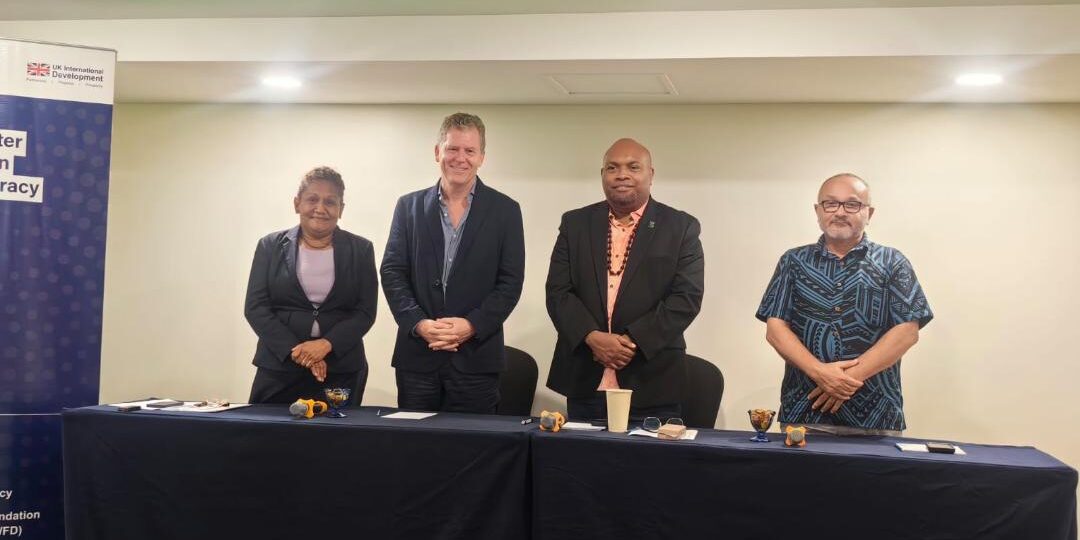
Minister for Women, Youth, Children and Family Affairs, Cathy Nori, has called on women to support female candidates in Parliament, saying women’s votes are often influenced by their partners during elections.
Minister Nori made the remarks following research findings showing that some women are discouraged by their partners from voting for women candidates.
Mrs Nori, who won the Maringe Kokota seat in Isabel Province in the last national election, said women can sometimes be their own worst enemies by failing to support other women.
She was speaking during a panel discussion at the Women’s Political Participation Forum held at the Heritage Park Hotel on Wednesday.
The forum was held under the theme “Addressing Financial and Cultural Barriers that Limit Women’s Political Participation in Solomon Islands.” It aimed to provide a platform for dialogue, knowledge sharing and action planning to strengthen women’s political participation.
“I think we have to prove to our male colleagues that we can do just as well as they can,” Minister Nori said.
“If women stop voting for women, that is the only way women will not get into Parliament.”
Meanwhile, Leader of Opposition, Matthew Wale, shared a different perspective, saying women are often the most discerning voters.
“In my years in politics, I’ve found women to be the hardest to persuade,” he said.
“They think deeply about issues affecting their families, villages and communities, unlike many men who often come asking for school fees.”
Mr Wale, the Member of Parliament for Aoke/Langalanga, said women candidates sometimes take female voters for granted, particularly in rural areas.
He also acknowledged that husbands influencing their wives’ votes remains a real issue.
“This is something that requires continuous civic education by the Electoral Commission, Non Government Organisations and all of us,” he said.
Chief Electoral Officer Jasper Anisi also encouraged mothers to involve their daughters in political discussions.
“Sometimes mothers tell their daughters to stay in the kitchen during political conversations,” she said.
“We should be encouraging our girls to sit, listen and engage in discussions about politics and the future of our country.”