
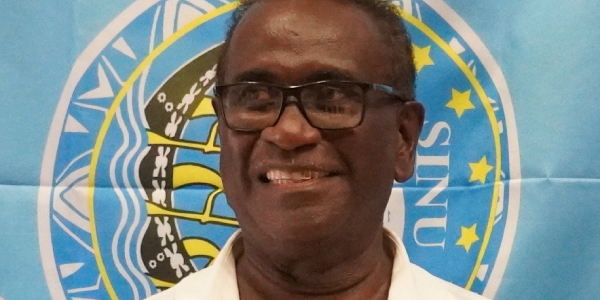
The re-appointment of my fellow Roviana brother Dr. Transform Aqorau as the SINU Vice-Chancellor for a second term after a rigorous, transparent, and comprehensive recruitment process is a sweet serendipity for me.
To have one of our sons being called out twice to lead an array of academic leaders in such a notorious institution as SINU manifests the analogy that no institution can risk reforming academically without such confidence.
Such confidence is a regaining of Roviana people’s confidence and not only that SINU’s decision is vindicated, but it challenges our paradigm to re-assert our position in the echelons of our leadership in Roviana.
We Roviana people have gone through a state where we disparage and depreciate our own traditional hierarchy of leadership maybe due to an overwhelming impact of the scourges of our civilization.
Dr. Transform’s re-appointment should be nourishing our Roviana souls, and we owe this to SINU for reminding us of our potential that we can once again re-design our ethos.
It is this reminder that gives me greater pride to raise a toast to all fellow Roviana people.
Fellow Roviana, let us feel humbled to borrow from Dr. Transform’s re-appointment of confidence. In sharing this sense of pride, I will attempt to measure the annals of history of our past leaders as a yardstick.
Schopenhauer’s assertion says, ‘that only through history does a nation becomes completely conscious of itself.’
One of the sources of the authority of Roviana leadership in the past requires the positive sanction of the dead, of the ancestors from whom all power ultimately derives.
However nowadays it could be said that Roviana chiefdoms impinges on modern day political and economic environment, and therefore leadership today is bestowed by the living, yet we are seeing a growing decay of authority among the scattered potentials.
Today, it seems that other islanders have gained a higher place in the national scene. The reasons for this could be easy to find: maybe no incentives or public awareness for people to realize the slow decay of indigenous leadership especially in Roviana through lack of zeal and the increasing interest of peer group rivalry leading to family feuds, and there could be other reasons.
Munda was the main centre for headhunting, but it has also become the centre of European and Asian commerce in the region. The two occupations were not incompatible and has shaped the paradigm of our leadership.
And so as we bestowed one of our Roviana sons into the national university, I crave for our ancestors and our forebears as we skip a while back to the annals of history lane for a glimpse of our leadership of the past. I have every confidence that some of my Roviana comrades will fully vindicate this article.
To somehow start the avalanche of our Roviana braves…let me quote Edward Terry Wickham. The son of Frank Wickham (q.v.) and Pinge Naru, he was raised in the Roviana Lagoon entered amateur swimming and won the national 100-yard championship and New South Wales 220-yard breast-stroke championship in 1912-1913.
Significantly, he was considered for the Australian Olympic Swimming Team in 1912. Edward moved to Adelaide in 1913 and won the 220-yard Championship of South Australia in 1914.
At the outset of the First World War, he travelled to England and enlisted in the 1st/6th Battalion, London Regiment (City of London Rifles). Edward was killed on 15 September 1916 in the Battle of the Somme.
Then came the Australian ‘crawl’ swimming stroke which in fact had its origins in Roviana Lagoon (q.v.) in the Western Solomons. Most significantly, Alick pioneered the crawl, or freestyle swimming stroke, but his most famous achievement was a high-dive of sixty-two metres (205 feet, 9 inches) into the Yarra River in Melbourne in 1918 at a patriotic swimming carnival.
His achievements have been recognised in several television, movie and radio documentaries, in books and newspaper articles, and by the International Swimming Hall of Fame in the United States and the Australian Sporting Hall of Fame.
In the Solomons, Alick was posthumously honoured by the naming of a swimming pool in Honiara in 1973 and by the release of a commemorative postage stamp booklet in 1984.
Then came the Second World War in 1942. Quoting from two book sources: 1. “Among Those Present” – The Official Story of the British Islands at War (Prepared in the Colonial Office by the Central Office of Information in London) and 2. “New Georgia pattern for victory” by D.C. Horton, published by Pan/Ballantine, USA, in August 1972.).
During the scourges of the Second World War certain brave Roviana people were, Biuku Gasa, Hugh Wheatley, Bill Bennett, Peter Sasambule and Daniel Pule. These fine Roviana men were descendants of the old Roviana head-hunters whose humble abodes were torched by the British Navy because of British retribution against what they thought was a gruesome act in headhunting.
In this incident they have taken up duties to help save Solomon Islands after the British have virtually ‘abandoned’ them to the hands of the Japanese Imperial Forces. We thank them for showing that Roviana people do not hold grudges and can do well even though they may have been mistreated.
The story of Biuku Gasa is well known in the history of the war in Solomon Islands. He was one of the few locals drafted by the allied operations as guides, carriers, labour corps, scouts, coast-watchers, messengers, wireless operators, etc., in the Western Solomons.
He was a scout who scourged the coasts as well as the inlands for any ‘enemy’ presence. This might be a lowly job or contribution to some, but such is the great pride of this Roviana Brave who delivered the famous President JFK back to the PT Boat Command Post at Lumbaria from enemy hands at Olasana Island.
Acting on instruction from the Gizo scout leader Sereke, Biuku took on a reporting mission taken by canoe through enemy-infested waters to deliver to Mr. Evans at Hipera hill on Kolombangara.
Biuku is remembered for this symbolic gesture as a lasting memory of our Scouts and Coast watchers, we will re-ignite knowledge as we once again learn about our significant contribution to our World War II history, and hopefully the heroic adventures and the final analysis of their life’s experiences will ensure that their stories are not closed and forgotten.
A letter by JFK himself from the White House on March 11th, 1961, addressed to just Dear Biuku, quote, …You will always have a special place in my mind and heart, and I wish you and people continued prosperity and good health…unquote, sums up his heroic adventure well acknowledged.
This was Biuku’s genealogy. Tae Banagara married Burovuto and begath Gove. Gove married Maliavara and begath Masipitu. Masipitu married Vurunaru and begath Vaqe. Vaqe married Uzili and begath Elona.
Elona married Dao from Kohigo Leanabako and begath Alesasa. Alesasa married Sarah Vaze daughter of Aqo and begath Biuku. Biuki was adopted by Isikeli Gasa (from Kindu) and Idadao. We salute Biuku and the Elona and Aqo/Simaema tribes of VonaVona Lagoon, Western Province.
Soon after the evacuation by the Morinda Marchant moved his headquarters from Tulagi to Auki on Malaita. The most urgent problem confronting him in those early days was that of repatriating more than two thousand native labourers who have been left stranded on copra plantations mostly in the western and central islands of the group.
Many Malaitans in the plantations in the west were agitating after seeing their trader bosses left, most of them in the Fauro Chief that called in west.
Marchant had to work against time for Japanese landings were already encroaching the Shortland’s group and expected landings in the west was imminent.
Marchant hurriedly pulled together a tiny fleet of schooners varying in size from 7 to 20 tons and put to plan a shuttle service that would make repeated voyages through waters where Japanese naval and air supremacy was unchallenged.
On more than one occasion these schooners were bombed and strafed by Japanese planes, but the native crew carried on fearlessly, and within a fortnight the last labourer had been safely returned to his home island.
Marchant found amongst not so many in Tulagi a fearless native from Roviana by the name of Peter Sasambule. Peter was the resident skipper of the Resident Commissioner’s schooner Tulagi, took the leading part in these rescue operations and later, despite the attentions of Japanese airmen, kept up a regular launch service between Malaita and selected points of rendezvous where District Officers stationed in occupied areas came to collect supplies.
In fact he was the Marchant’s only shipping link serving his exile headquarters in Malaita. Peter was a son of Aqo from Vona Vona. This was his genealogy. Nadariko married Minuvu and begath Vaze. Vaze married Buala and begath Idamali. Idamali married Iraveo and begath Aqo. Aqo married Dinimali and begath Peter Sasambule. We salute the bravery of Peter Sasambule and the tribe of Aqo/Simaema in VonaVona.
In West, District Officer Donald Kennedy who voluntarily decided to stay behind and fight the war in Solomon Islands, had his own flotilla of schooners, which constantly ran the gauntlet of enemy bombing and strafing.
His finest ship was the 14-ton Waiai which had been built in Australia for the Protectorate Government and had sailed up from Sydney, across more than a thousand miles of ocean. Kennedy’s most trusted skipper and command was a young half-caste NCO from Roviana by the name of Bill Bennett.
In one or other of his schooners Kennedy visited all important villages. Bill Bennett was instrumental in these visits, running errands for Kennedy and help fight the Japanese. This was his genealogy.
Tokoro married Holatina and begath Gorebangara. Gorebangara married Tirurade or Sinarade and begath Sagelamana. Sagelamana married Lipuvuru and begath Pakovari. Pakovari married Kade and begath Imatako. Imatako married Bennett and begath Bill Bennett. We salute the bravery of Bill Bennett and the Lipuvuru clan.
On April 10 the Japs landed at Faisi, in the Shortlands, and during one of their forages for expatriates they took prisoner Hughie Wheatley, a half-caste native from Roviana. Hugh was a medical practitioner who had himself landed only a day before.
He had gone to the Shortlands, well knowing the risk he ran, because he had received reports of an outbreak of pneumonic influenza. Hughie Wheatley was the bother of Kitchener, Ellen, Agnes, Joyce, etc. This was his genealogy. Loa Bakiha married Naponapo and begath Dikumali. Dikumali married Qorana and begath Somoe. Somoe married Takopiqe and begath Leikolo. Leikolo married Olorade and begath Sabevido. Sabevido married Norman Wheatley and begath Hugh. We salute the bravery of Hugh Wheatley and the Somoe clan.
Martin Clemens was at his headquarters in Aola when the Japanese went ashore at Tulagi. With him he had 18 policemen, twelve serviceable rifles and 300 rounds of ammunition. About the middle of May native canoe patrols which had been keeping watch at Tulagi reported that the Japanese were preparing to land on Guadalacanal.
Clemens then proceeded to take the Government station at Aola to pieces and remove as much as was possible to take to the village of Vungana in the foothills behind Aola. Although from now on, his pre-occupation was largely of a military nature, Clemens did not neglect his routine duties as District Officer. He established two sub-stations, with Clerk Daniel Pule, a Roviana man, and Police Sergeant Andrew Langabaea from Malu’u.
During the Battle for Guadalcanal, there were many accounts of the heroic bravery of the locals but one of our Roviana man also took active part of them all.
Daniel Pule was instrumental in one exploit resulting in the liquidation of the Japanese outpost at Gorabusu. In mid-October a party consisting of 53 Japanese naval officers and ratings landed near Marau Sound to choose a site for coast-watching station.
From the moment they came ashore they were shadowed by Clemens’s men. It was Daniel Pule who made the maps showing their exact dispositions and defences.
At dawn the Marines and the islanders charged into the camp and within ten minutes the battle was over. Daniel Pule was a man from Munda, Dunde. This was his genealogy.
Tok’tokoro married Saberiko and begath Gorekana. Gorekana married Haepiqe and begath Noneke. Noneke married Laopiqe and begath Quladuri. Quladuri married Naquhebala and begath Daniel Pule. We salute the bravery of Daniel Pule and those from Tok’tokoro line.
Those were during the scourges of war, and then peace came as the British colonial administration began setting its native foundation in around 1951/52, Milton Talasasa became one of the first native members of the BSIP Advisory Council.
In 1961 Mr. John Lianga Gina was appointed with E.V. Lawson, Mr. C. G. Fox as a sub-committee member to organize and supervise the spending of 1,300 pounds that year on playing field improvements, it was agreed that improvement to the hospital ground should have priority. And this was the improvement of the first Lawson Tama field.
An Education Department was established in Honiara in 1947, with a brief to open government schools and Auki Experimental School, also known as Aligegeo School and later as King George VI School borne in 1947.
One of the first on the school staff was another son of Roviana by the name of Norman Kitchener Palmer later Anglican Archbishop of Melanesia.
Now I come to Francis Aqorau (Talasasa). Not surprisingly he was Dr. Transform’s father. Francis Aqorau attended the Anglican All Hallows’ School at Pawa before attending Queen Victoria School in Fiji and St. Andrew’s School in Christchurch, New Zealand (1949-1953).
Studied at the University of Canterbury (1954-1957), becoming the first Solomon Islander to earn a B.A. degree. On his return, Talasasa was posted as a Cadet Administrative Officer on Malaita in 1959, and he subsequently rose through the public service ranks to become the first Solomon Islander to be appointed a Deputy Commissioner, and later, in June 1962, the first to be appointed a Magistrate.
During 1964 and 1965, he was Clerk to the Legislative Council (q.v.), and in 1966 he became the first Solomon Islander to be appointed to an overseas government position when he became a District Officer in the Gilbert Islands.
To add a whip of icing on the gender balance, I must quote a cousin of mine by the name of Elisha Pao Dhari whom records tell that she was the first registered woman to drive a moto vehicle in Honiara.
The contribution of Sir Lloyd Maepeza Gina is worthy to mention being an administrator and a Government Agent and second Speaker of the SI National Parliament.
As we look into sports, we recall BSIP participant Warren Alebule Paia competed in athletics in the 1963 SP Games in Fiji as a sprinter. In the 1966 South Pacific Games in Noumea John Sogabule competed in high jump.
Leading on in the 1969 SP games were Adrian Wickham and Akuila Talasasa in Rugby. Later athletes like Charlie Oliver, Aron Hitu and Mackay Talasasa came forward. Then came John Wheatley, Alan Boso, Nelson Boso, Donald Bennett in soccer.
In the field of music, such pioneer names in lotu music were John Veo Bitibule, Isaiah Zomoro, Joel Zio, Belshazzar Gina and the secular music from Semion Tavaeke, Lazarus Pania, John Willy, Ronald Bei Talasasa, John Lianga Gina, Selwyn Talasasa.
To cap it all up, in the mid.60s the Roviana lingua franca was used as a third language of the national news that was broadcasted by the national broadcasting station.
The desire for westernization may have overshadowed whatever wish we Roviana folks might have to re-develop and maintain in public, at least our leadership. We can at least have a uniquely Roviana identity through leadership.
And our cultural values, both conservative and adaptive will continue to determine the nature of leadership today and many years to come.
For now, I wish to say thank you to brother Dr. Transform for giving our new Roviana leaders a ray of hope. Leana Hola. Tataru nia Roviana.
By Nelson H U Boso,
Noro Town
(Footnote: Nelson H U Boso a, popular sportsman and administrator, a former Government Public Relations Officer with the SI Government Information Service in the 1980s, currently resides and works in Noro Town.)
