Commentary By Nelson H U Boso
In Noro
In the mid-1970s, politicians in the Western Solomons agitated for statehood status. It’s a long story but ever since leaders have one way or the other been negotiating through consultative meetings and resolutions on Federal Government in the Western Province.
The issue is as agonizing as its own sunset – trying to ravel out its complicated logic and the series of efforts that had led to this situation.
Whether to roost or rust is a matter to ponder on. Even the Greek mythological god Janus – symbolising the animistic spirit of doorways (januae) was represented by a double-faced head, one looking east and the other looking west.
I wonder which of the two faces will eventually get the nod. But for a few, the issue could somewhat be a sweet serendipity to honour past Western leaders’ agitation and dialectic mood.
Whatever the outcome, State Government has become a political signpost of Western political history and an aspiration and inspiration of many of its past leaders.
Am not so sure about our current generation but they too might regard it a special subject remembering the past efforts a mark of jubilation for our past leaders and past people for marking the culmination of their vows as our identity.
One cannot speak about it without speaking geo-politically and I wish to touch very briefly with a very broad brush on this topic. Let this be a tribute.
But before I do so, perhaps it is appropriate for us to reflect a little on the institution itself – Western Province.
When Western Province Government was established under the Provincial Government Act of 1981 in around 1982/3, we had the island and people of Choiseul with us as one regional government namely the Western Council.
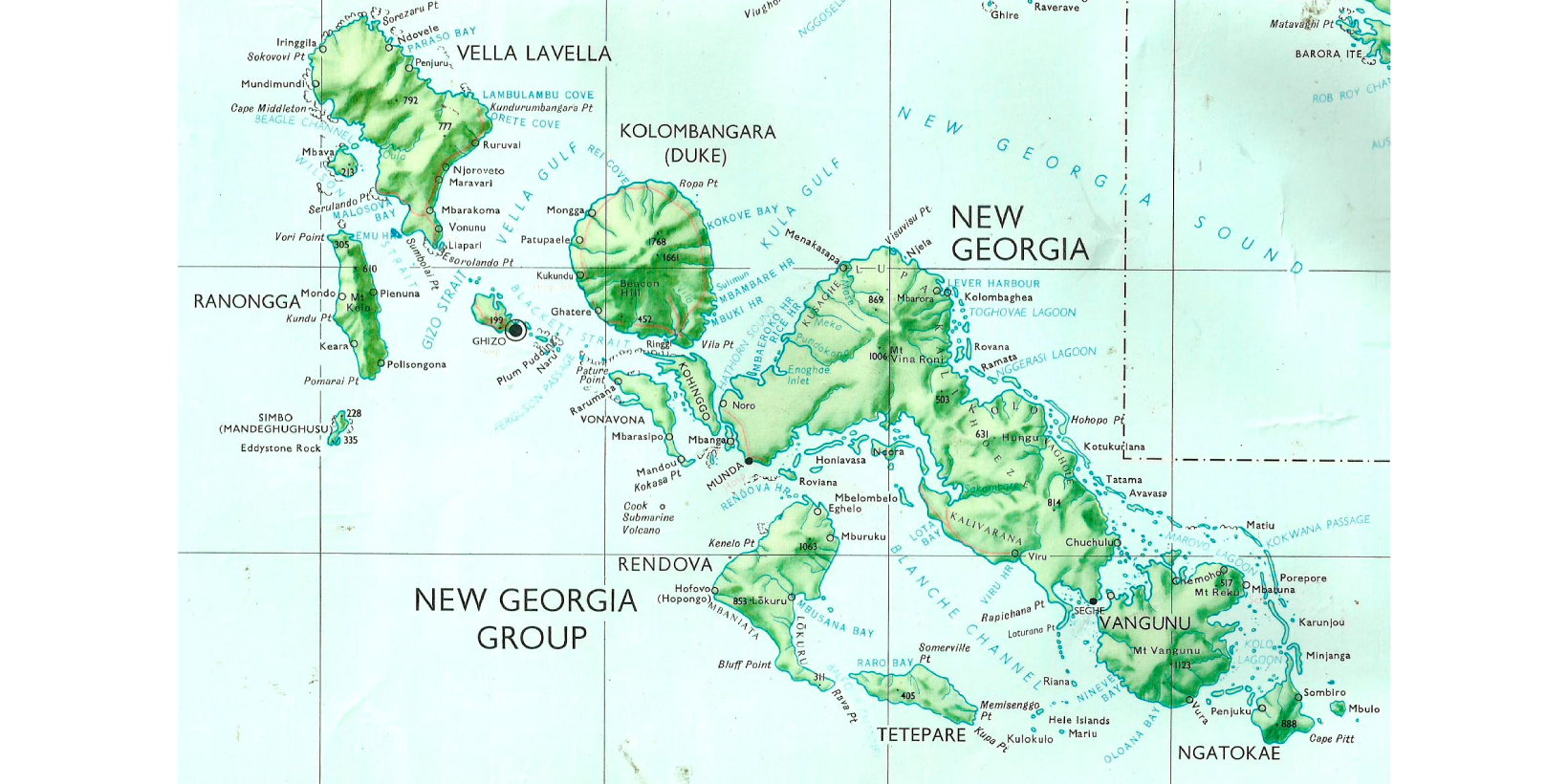
The total land area at that time was approximately 8,660 square kilometres. Of this total area are the following main islands: New Georgia including Gatokae, Vangunu, Kohigo/Parara, etc. (5,000 sq. km), Rendova (400 sq. km), Tetepari (120 sq. km), Kolombangara (685 sq. km), Gizo (37 sq. km), Simbo (12 sq. km), Rannogga (145 sq. km), Vella la Vella (670 sq. km), Choiseul (3,210 sq. km) and Shortlands (420 sq. km).
However, in 1995, Choiseul Province was split from Western Province, taking away 3, 210 sq.km of land leaving the Western Province with a total land mass of around 5,450 sq. km.
So, the total land mass of Western Province, as it is now, is around 5,450 sq. km. This is approximately equal to the rich nation of Brunei.
By comparison, we are bigger than Samoa (almost double) who has only 2,831 sq. Km.
We are even bigger than Tonga having only 748 sq. Km. And by the margin, we are bigger still than Kiribati which has only 811 sq. Km of land mass.
Even the main island of the New Georgia – 85 Km long 41 Km wide at its broadest point and having 2,145 sq.km is even bigger than Tonga and Kiribati combined.
Those of you from Kolombangara – average 30 km diameter having a land mass of 685 sq.km. is almost the size on the Dominica and maybe larger than any other Caribbean country.
Gizo, our provincial capital – 11 km long and 5 km wide and having 37 sq. km (including all its islands) is almost the size of Norfolk Island.
As you meet in Gizo remember that the Island is bigger than Nauru having only 21.3 sq. Km., or even much bigger than Tuvalu with only 26 sq. Km
For those of you in Rendova 40km long and 400 sq. km., you are almost the size of Barbados with 431 sq. Km
Tetepari, 26 km long 7km wide at its broadest and having 120 sq. km is almost the size of Christmas Islands.
So here is Western Province and its land mass and the resources endowed with it both land and sea.
What a potential! How much more is our maritime area? With our potential land mass and seas and the passiveness of our beautiful people we do have the potential. So why are we experiencing economic and social stagnation?
In terms of civil infrastructures, the Second World War in Western Province has left us with some key military infrastructures like airfields and roads.
Munda International Airport, Odongo airstrip (dual fighter airstrips), Sterling Island airfield (having airports bays), Balalae airstrip, Barakoma airstrip and Seghe airstrip, are there for upgrading.
The rise of Noro with its International Port connected with the Munda International Airport by Noro/Munda ‘Highway’, coupled with the new road upgrade and the new Finance & Treasury Office, Fisheries and Police is a rise in esteem.
Nusatupe airstrip being a late addition in the late 1960s, with one airstrip at Ringgi (though neglected), used to be one at Barora, one at Ramata, one at Batuna and I think one is at Geva on Vellala Vella. Infrastructures usually grow out of company stations so we could be looking at Ringgi and Poitete on Kolombangara and the Eagon station near Viru. All these are potentials.
We have copra, timber and other potential commodities that need to be investigated.
There are many logging roads left to revert to bushes. These can be connected to open up economic activities.
In terms of comparative analysis, we have the highest copra production quota and the highest forest out-growers scheme.
So, it’s no wonder that these had stemmed political agitations in Western Province that resulted in a lot of discussions and heated debates by Western leaders.
What the National Government did to appease the Western mind at that time was granting Provincial Government Systems.
But lest we forget, the whole spirit of the Provincial Government was about the Devolution of certain Powers and Functions, nothing more nothing less.
It could be by virtue of the date of the putting of such provisions of such powers and functions into the Act is what is known as the First Appointed Day.
The actual date of transferring these powers and function sometime in 1982/3 (am still looking for the gazette to verify this) is what is known as the Western Province Second Appointed Day, which is the 7th of December now celebrated in each calendar year.
It was said that this early devolution was only in the field of Health, Education and Agriculture, nothing else.
Our greatest question now is what the current status of this original devolution is as mentioned earlier. Some thinkers believe that after only a few years, these powers were taken back by the National Government, leaving Western Province bare of any powers. Sometime in 1997 we had a revised Act and if this is the re-calling of these powers then we need to know whether we have been unethical about spending official time and funds in celebrating such an occasion.
I leave this to our leaders to ponder on. And the underlying question of the 1997 Amendment entered the legislature to be enacted or just powered by ministerial regulations and Cabinet approval.
What matters is us – the people of Western Province. What have we been doing or what are we doing now? We seem to be still in a state of profound crisis.
It has been more than 40 years of our Second Appointed Days when we should realise this province with opportunities to determine and implement responsive forms of development to the well-being and needs of our people and our resources.
Where are our own hands which we can show for in terms of economic achievements? Where are the fruits of such amounts of public resources into our wards and villages, are there tangible developments we can point to?
Are there signs that our provincial government seems to be in the service of others other than the very people for which it exists?
Are there elements drawing excess profits from their interest? Are there penetrations in our political systems, our culture and our way of communication?
Are there infiltrations into our ideologies, our way of life so much so that today we are most in contradiction with each other and morally in decay?
We were once labelled a lazy province in that infamous scurrilous poem – ‘Ode to the West Wind’ during our agitation for more autonomy. This was an undue damage to our paradigm.
Most of the Solomons’ plantations were in the West during this era, but even before these plantations were established which recruited other islanders to work these plantations, Western people already were selling their copra to the planters and traders and saw no reason to work in the plantations. They were already traders in the sense of things.
What was wrong could be a system that does not correspond to the needs of our time.
So, we ask ourselves. Are we still able to do things? Do we still have focus? Have we stopped looking for opportunities to grow the economy? I think we must stop talking. Let us just get on with things and do them.
Because we could be dragged down with the habit of “all talk” and less action. We spend much needed finances in meetings that carry no effective resolutions, have never been implemented, reviewed or evaluated.
Each time we end up saying, “bae me duim behind” (I will do it later). Or we postpone meetings or defer actions that are vital and prompt. The proof-of-the-pudding is that things never get done.
Someone said some time ago that procrastination is a cost to our community and Western Province government cannot afford to do this kind of behaviour anymore.
We must focus our time, energy and resources on how we can “Just get on with it and do It” and I am sure we will see change in our development.
I put it into a kind of ‘B’ bracket status. I subscribe to the notion that what is good for the native westerners is good for all western.
With due respect to our learned academia that we will reason away to political viability through academic exercise is both naïve and unrealistic.
Many of our western leaders do not ignore significant numbers with political will. Not simply loud voices but in organized community with one singular voice.
- The misnomer relations between our 9 national MPs and our 26 MPAs, who have not set out to map out common strategies for the Western region.
- The great big question of how big is the Western Province economy? What percentage of the national GDP is contributed by Western Province?
- We need to encourage an economic forum involving the private sector and the informal sector experts can be brought in and have a voice in whatever strategies we plan.
- Thoughts about the future economic relationship with Bougainville, Choiseul, and the western region of Isabel. How do we nurture it?
- How can people from Western Province living in Honiara have an annual program to contribute and bring together ideas, strategies, etc., to support our leaders?
- How can we create more opportunities for employment for our youth?
- Are we ready for the so-called state government?
- How strong is our education and human resources system in Western Province, especially in the tertiary level?
- How do we prepare to adapt to climate change and develop a low carbon economy?
- How do we give more opportunities in empowering our women?
- Bougainville just came out of a major crisis or war, but they are already ahead of us in actively getting the women in politics and development planning.
Political observers are standing by to see if we can mobilize the roles for several things.
One is to raise our province. Secondly are we skillful enough as westerners to be able to transfer that strength into state politics.
One observation is clear. Throughout history, governments, whether it be democracy, or a monarchy, or republic, or aristocracy, or dictatorship, for whatever reason changes.
But our province or a provincial identity will always remain. Provincial building includes the creation of provincial regalia, such as the provincial flag, provincial colours, the coat of arms, emblems, the seal, provincial models, and of course provincial anthems.
Today the word province is often synonymously used with the term state, but the state is more properly the governmental apparatus by which a province rule itself. This rulebook is called the constitution.
And hopefully one day soon we will convene a constitutional convention that will ultimately provide the rules for our province. On this matter, a draft State Constitution has already been done.
While we organize our native Western governing entity, I would like to emphasize the importance of native western political strength in the existing native government apparatus, the state of western.
Our Province is no more or no less a gathering of human beings. Early conceptions of our province defined a people with shared a history, traditions, shared culture, sometimes religion, most definitely language.
This is a common national identity that the province wants. It is the shaping of a right identity.
The human beings of Western Province are as worthy as the human beings of Honiara. Sentiments have been raised about a growing divide between our Province and Honiara.
And I will applaud our 26 MPAs if they are making us come together in the array of thoughts. I look at you and I see partnership and development. This in my opinion is the intervention or action that we need.
It is an indigenous process that we are going through right now. I see something that can create for our leaders for they need to re-assure and provide signs of hope to us. It is our garden. A new Jerusalem of thought.
As we continue to evolve, the garden stands as a powerful symbol and our province will rise again. It will blossom in a righteous way.
Let us be seeing a new Western mind that aim at the unification or and in this case, re-unification of our province and its people within a specific model which must be determined so that it remains politically viable and stable in the long run.
It is what we see. It is what we should all feel. It’s a provincial anthem, a provincial symbol. It is our identity. It is our livelihood and our cleft in times of trials and tribulations.
(Footnote: Nelson H U Boso a, popular sportsman and administrator, a former Government Public Relations Officer with the SI Government Information Service in the 1980s, currently resides and works in Noro Town.)