By Nelson HU Boso,
Noro Town.
Once again, its December and we are in another season of nativity known to many Christians, and perhaps other religions, as Christmas.
Once again, we as parents and guardians will be pestered into or nagged at by our dear ones. And it is about this queried persona non grata – Santa Claus a.k.a. Father Christmas.
By the naggings, we will, for better or for worse, be pushed into tight corners trying to figure out or mitigate a compromise between our children’s Xmas wish lists against our meager income.
To hear our kids challenging our ignorance about Santa Claus and how and when he will pass by our lonely doorstep will bring us an equal measure of tears and anger. Our tears will be for the inspiration of the idea of a gift-giver to our children.
Thanks to Santa we will have an atmosphere of hope even for an eve’s night and dawn break. Happy are those that could afford bigger gifts for their children and vow to us that could not afford a decent toy and deny the guilt.
Our anger (perhaps for a diminishing few) will be for the continuing ignorance of our children and the cost of it too. So, who is this fellow Santa?
Why should this old man from the North Pole or wherever he originated from, baffle us into the oblivion? How come he is having unrestricted access into the minds of our marginalized children in tropical Solomon Islands?
The Santa Claus tradition is a rich tapestry woven from the life of Saint Nicholas, various cultural practices, and evolving folklores.
Today, Santa Claus is celebrated worldwide as a symbol of generosity and joy during the Christmas season, embodying the spirit of giving that transcends his historical origins.
The faces of our kid’s smiles waking up sleepy-eyed on the dawn of Christmas Day to find their gift fruiting from the glittering Christmas tree is truly a rare phenomenon. It melts our hearts.
Santa Claus’s story begins with Saint Nicholas, a kind and generous bishop who lived in the 3rdcentury in what Turkey is now. He was known for his many acts of kindness, especially towards children and the poor. One famous story tells how he secretly dropped bags of gold down a poor man’s chimney to help his three daughters get married, which is why we hang stockings by the fireplace today. He did have a Mrs. Claus.
His feast day is celebrated on December 6, and he became the patron of children which laid the groundwork for the gift-giving customs associated with Christmas. On Christmas Eve, Santa travels the world in his sleigh, delivering presents to children who have been good throughout the year.
Over the centuries, the legend of Saint Nicholas spread across Europe. Different cultures celebrated him in various ways. In the Netherlands, he was known as Sinterklaas, and when Dutch settlers came to America, they brought this tradition with them. The name “Santa Claus” is derived from “Sinterklaas”.
In the 19th century, writers and artists began to shape the modern image of Santa Claus. Clement C. Moore wrote the famous poem “A Visit from St. Nicholas” (also known as “‘Twas the Night Before Christmas”), which described Santa as a jolly man in a red suit who travels in a sleigh pulled by reindeer.
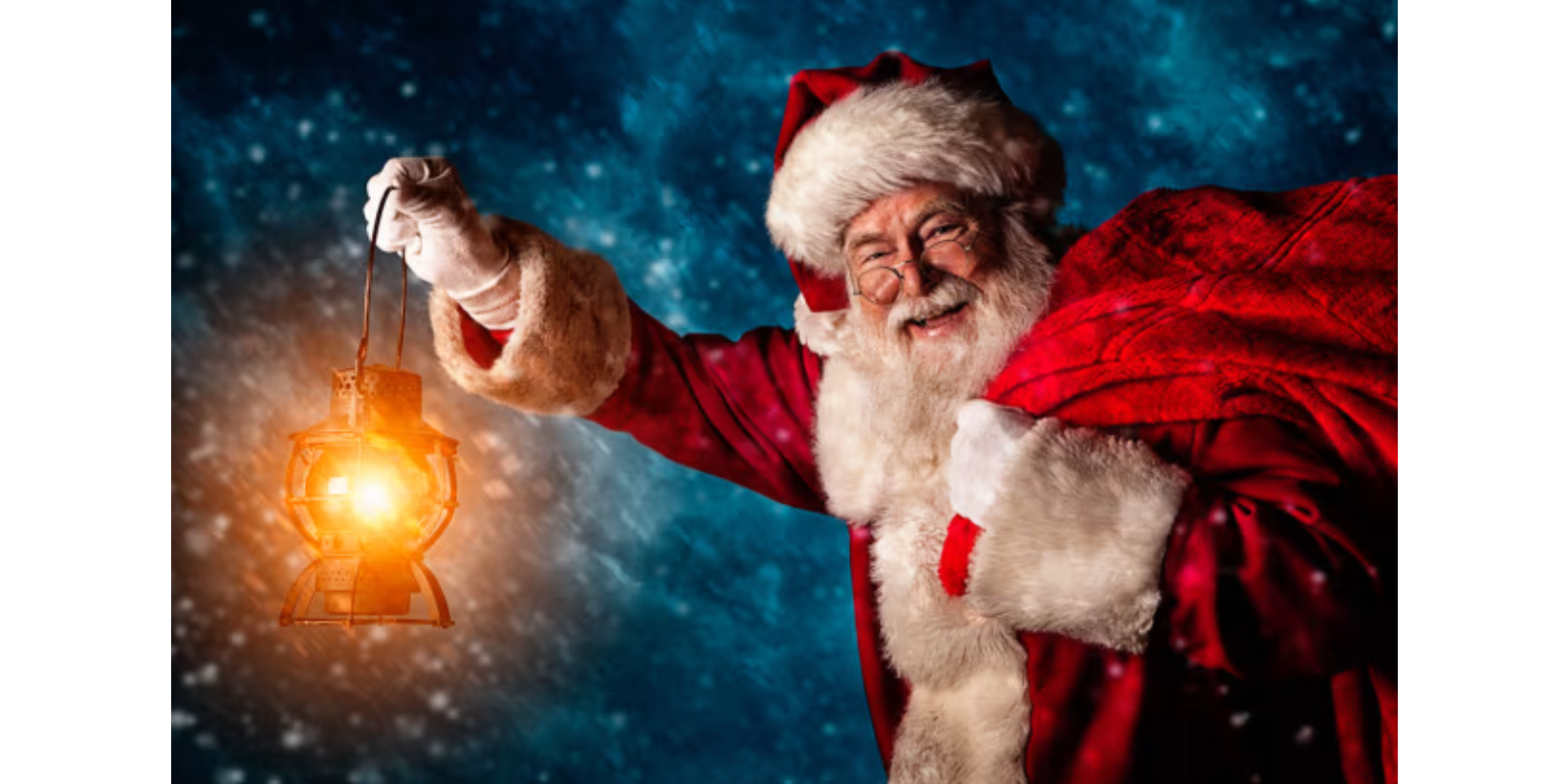
Today, Santa Claus is depicted as a cheerful, plump man with a white beard, wearing a red suit with white fur trim. He is known for his hearty laugh and for bringing gifts to children around the world on Christmas Eve. Santa lives at the North Pole with his wife, Mrs. Claus, and a team of elves who help him make toys.
Santa is known by many names around the world, including Father Christmas in the UK and Père Noël in France.
Herepresents the spirit of giving and joy during Christmas, reminding us all of the importance of kindness and generosity. His story continues to inspire children and families around the world every holiday season!
I would agree the Santa Claus tradition has been introduced with the imported teachings of Christianity way back in the mid-1800s to the early 1900s and the tradition has stuck and has been part of our culture ever since.
As such it would be a basket case to try and erase it from our society. And I am not yet saying that. But it is not unlawful to raise such questions just for the sake of reading and thinking about how we will spend Christmas with our nagging children in our various homes.
Why is the Santa Claus tradition important for the mentality of our children in Solomon Islands? Is the tradition transparent enough? If not should vigilante groups such as Transparency Solomon Islands do us a favour by explaining this traditional practice and urge all to tell the kids the truth? This is the most Christian and transparent way isn.t it?
Or is the truth of this Santa Claus tradition strictly a tabu and is sacred and should just be worshipped rather than investigated?
How Santa navigates is a truly another wonder. How he could mark even the artificial islands of the Solomons in his GPS is a masterpiece hacking into their privacy.
Not only is he a capitalistic millionaire, but he is also a very good socialist philanthropist as well. His devilish Ho ho hos and his cynicism leave much to ponder over. He usually chuckles afterwards in an “I gotcha” manner. Many parents fall for him in all aspects of the Christmas tradition even if he never produces an audited financial statement.
His white beard reminds me of Moses that brought us the greatest gift of law, but my joy faded upon learning with great dismay that our Santa has the habit of creeping down chimneys like a criminal in the most silent of night to covet the unsuspecting neighbours’ wife and kids.
How he maintains his cleanliness and a clean bill of law after his night’s workout down and up the chimney is another one of his delights.
He is supposed to buy my kids presents. But he is deceitful and has a clever decoy. He gets all the praises, and his legend gets multiplied whilst my meager savings get dwindled to the bones and worst still is when I am blamed for giving Tom a bicycle, Dick a toy gun, and Harry a packet of glow sticks. When such trouble in the home occurs, his boisterous ho ho hos are heard from our next-door neighbour as he scrambles on. Santa is nowhere to be seen – the culprit.
The choice of his outfit certainly will fail him at any supermarket entrance. It has too many inside pockets and his bulging tummy looks too artificial to be honest. His choice of a red over-coat could depict a sangfroid rider with blood on his hands and his attraction to juveniles could depict him as an unsuspecting pedophile.
Pressure groups for women rights in Solomon Islands could start redefining his gender so that by Christmas 2026 we should have an indigenous Mrs. Santa for a change.
The ideology of an unshaven riffraff from a village outpost somewhere in Sweden or Norway and depict him as a million-dollar spender for children all over the world is truly a Christmas Wanderlust. How he fits in all his goods in a pair of socks and circum-navigate the entire globe in a sleigh faster that the speed of light is astronomical.
And to keep account of the millions of customized packages is like looking for a needle in a haystack.
Certainly, his bookkeeping ability is a great feat and should be a case study for a student in accounting. Secondly, a sleigh is only good on snow. How he slides over Mount Tatuve to the treacherous waves of Mary Island and end up skiing the Noro Harbour to locate my abode is hard to digest.
To have Rudolf, the caribou reindeer, pulling it at that speed whilst managing the deliveries should have been condemned by the World Federation Against Animal Cruelty. Organizations like Earth Island Institute should raise propaganda to stop the sleigh entering Solomon Islands.
Those looking after Solomon’s airspace should ban his sangfroid ride. Even the Pacific States ought to consider him banned as a persona non-grata.
Truly the subject of Santa is a subject of delightful ho ho hos. To be celebrating Christmas 2025 in our islands is to have exalted this European tradition. And we are, in no uncertain terms, contributing to our demise through our trade imbalances. And we have once again exalted the spirit of commerce rather than the virtues of Christmas and the birth of Jesus.
In our Christmas tranquility and decorations, the final analysis is the hideous notion of trade with the real tradition of buying, buying, and buying until we see red. It is thus a wonder to know that Coca Cola played a pivotal role in shaping the modern image of Santa Claus.
In the early 20th century, Coca Cola sought to promote its beverage as a year-round refreshment, not just a summer drink. Subsequent marketing campaigns helped establish a lasting connection between Coca Cola and the spirit of Christmas, making Santa Claus an enduring symbol of holiday season.
And so red it is for Santa and interestingly red it is for China, the nation that supplies the most Santa goods on the market. It will continue to stand unabated to benefit from this deity even if they are not of European tradition or Christians.
On the one hand we can rejoice and sing for unto us a child is born in a manger, while on the other hand we have reason to be skeptical about a hairy old man creeping out of the snow somewhere in the North Pole and sliding into chimneys elsewhere.
While Jesus is riding on a mule talking love of men, Santa flies on a caribou reindeer for the love of money and a gruesome liar of men.
The death of the true Saints of the Cross and the spirituality of it happens almost simultaneously with the birth of Christ and Santa’s crafty economics. All this happened on Christmas Eve before dawn.
Whatever it be, here in Solomon Islands we are getting used to it and the economics of special days will continue to haunt us. Whether it is Christmas Day, Valentine Day, Father’s Day or Mother’s Day, or World this and that Day, things will never change. They will continue to repeat themselves into affinity because nothing is ever thought for a special Solomons Day where we can create our own good Samaritan Santa.
This Santa is no different from so-called local tricksters such as Abarai, Titahoro or Higalozi. It is how we create and depict that deity and accept him or her into the fabrics of our tradition is what matters.
Until we start thinking in such little ways, to boost the macro-economics of our tiny nation, no matter how absurd and ridiculous, the question about the tradition of Santa Claus will continue to insist and persist on our dire affordability.
Yet the underlying question is – Should we continue to traditionalize a culture of deception that is built around the greatest hoax of the globe and smear it on the early upbringing of our innocent children?
Does this substantiate child abuse? Or should we correct the untruthfulness and its direct adversity to our Christian values and tradition? For a country such as Solomon Islands where all works and walks of life seems a contradiction let us catch our young with true Christian principles and glad tidings and not the spoils of an imported material culture promoting an imposter and seemingly a pedophile.
Hope we will all enjoy our Christmas (Christ’s Mass) the way it should be. Let us put Christ before us. He is got to be our real Santa Claus each day the whole year round, as the song embraces.
GOD IS MY SANTA CLAUS
In a classroom at a great school just before the holidays
The boys and girls were writing notes to send them far away
Except a lad who sat alone his papers put away
And when his teacher asked him why so softly, he did say
For God is my Santa Claus each and every day
I don’t write him letters mum I just kneel and pray
Don’t you know his greatest gift Salvation that I found
Got to be my Santa Claus each day the whole year round
And then the teacher stood in silence at what the child had said
He really meant real Santa Claus and not from books he read
He really knew real Santa Claus he said in his own words
God gave us Christ for Christmas Day my Santa Claus is here
Merry Christmas 2025 olgeta families, friends and wantoks…each day the whole year round!