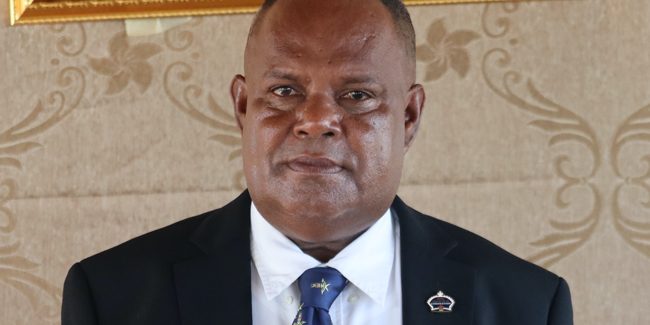
Governor General [GG] Sir David Tiva Kapu says he has no power to convene a meeting of Parliament due to a past Court of Appeal interpretation.
This follows a letter from Opposition Leader Matthew Wale, sent on Tuesday, 17 March at about 1:28pm, requesting that Parliament be convened for a vote of no confidence in the Prime Minister.
Sir David also referred to an undated petition signed by 28 Members of Parliament, which he received earlier the same day at about 8:30am, petitioning him to cause the National Parliament to be convened as soon as practicable.
However, in his response to Mr Wale, the Governor-General in a written response date 18th March said he does not have the authority to act on the request.
“Given this Court of Appeal interpretation of my relevant powers under the Constitution, I have no power to convene a meeting of Parliament,” Sir David said.
“It follows, therefore, that the Prime Minister and the Government will determine the date and time to convene Parliament, which I believe—through my consultation with the Prime Minister—will be as soon as government business or matters are sorted out.”
Sir David acknowledged concerns raised about the Government’s standing in Parliament.
“I am given to understand that the current Government no longer commands the confidence of the majority of Members of Parliament due to the recent mass resignation of some Ministers and Government backbenchers from the Government side.
“This triggers the call for my intervention to convene Parliament because Parliament is currently adjourned sine die and not in session, and that the Prime Minister may delay convening Parliament due to the current political situation,” he said.
He added that he had consulted the Prime Minister on the matter.
“I have spoken with the Prime Minister, and he advised me that the date to convene Parliament will be determined by the Government as soon as all government matters are sorted out and finalised.”
Sir David said his decision was based on legal advice and precedent.
“After careful consideration of the content of your letter and the petition, and after obtaining legal advice, I was referred to the Court of Appeal case: The Prime Minister vs The Governor-General (Civil Appeal Case No. 14 of 1998).”
He quoted the ruling, which states that the Governor-General must not intervene in parliamentary political processes, including making judgments about whether a Prime Minister has lost the confidence of Parliament or convening Parliament on the initiative of the Opposition.
The ruling further states that the Constitution does not authorise the Governor-General to convene a meeting of Parliament while it is not in session, except under specific provisions, and that such powers must be exercised in accordance with the advice of the Cabinet.