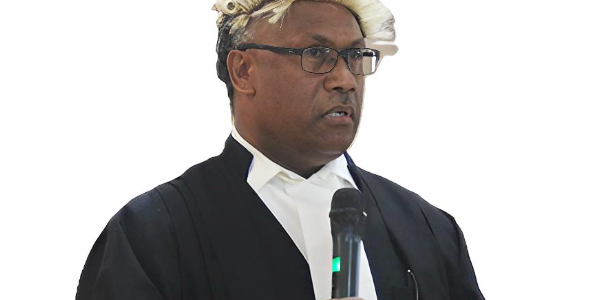
The Court found no indication that counsel’s independence had been compromised
By ASSUMPTA BUCHANAN
Solomon Star, Honiara
The High Court has dismissed an application to disqualify counsel representing Auditor General, ruling that the defendants’ arguments were speculative and lacked relevance to the issues before the court.
Lawyer Gabriel Suri was the subject of the application.
In a ruling delivered recently, Justice Augustine S. Aulanga rejected the application brought by the Pacific Games National Hosting Authority and the Attorney General, allowing the claimant’s counsel to continue acting in the proceedings.
“The Court is satisfied that the continued representation of the Claimant by counsel Suri does not compromise the fairness of the trial, nor does it undermine the proper administration of justice,” Justice Aulanga added.
He further added that the substantive issues pleaded in the amended claim remain focused on appropriation of funds, compliance with the Public Financial Management Act 2013, and adherence to Financial Instructions.
“None of the Defendants’ grounds for recusal bear directly upon those issues.
“Accordingly, the Court finds that the application for disqualification of the Claimant’s counsel is misconceived and without merit.
“The application for recusal of Claimant’s counsel is hereby dismissed,” Justice Aulanga ruled.
The case arises from ongoing litigation concerning financial oversight of the 2023 Pacific Games, with the Auditor General seeking declarations on issues including public fund appropriation, expenditure by warrant, and procurement practices.
However, the defendants sought to have the claimant’s lawyer removed, arguing that his prior involvement in preparing preliminary instructions that led to the enactment of the Pacific Games 2023 Act 2017 created a conflict of interest.
They further claimed that counsel could be called as a witness, possessed confidential government information from his previous role as Chairman of the National Sports Council, and had knowledge of the legislative framework that could prejudice the fairness of the proceedings.
Justice Aulanga rejected those arguments, emphasising that the core issues in the case relate to financial management and procurement processes, not the drafting or legality of the Pacific Games legislation.
The Court found that counsel’s earlier involvement in preparing a memorandum of instructions was too remote from the matters in dispute to justify disqualification.
On the question of whether counsel might be called as a witness, the Court described the claim as speculative.
While the defendants relied on media references describing counsel as a “main architect” of the legislation, the judge held that there was no evidence showing his testimony would be necessary or material to the issues before the Court.
The Court also dismissed allegations that counsel had access to confidential information that could be misused.
Justice Aulanga noted that the defendants failed to identify any specific confidential material or demonstrate how such information would affect the fairness of the trial.
In contrast, relevant documents, including the memorandum of instructions, were already in the public domain.
Addressing the broader claim of conflict of interest, the Court found no indication that counsel’s independence had been compromised or that he had any personal stake in the outcome of the proceedings.
The judge stressed that disqualification requires a real and demonstrable risk to the administration of justice, not mere conjecture.
Applying established legal principles, including those set out in Kallinicos v Hunt and SMM Solomon Ltd v Attorney General, the Court reaffirmed that the test is whether a fair-minded and informed observer would perceive a real possibility of bias or conflict. In this case, no such risk was established.
The Court also cautioned against the use of recusal applications as a tactical tool to disrupt proceedings, noting that disqualifying counsel is a serious step that must be supported by clear and cogent evidence.
In dismissing the application, the Court ordered that costs be paid by the defendants, with the amount to be determined if not agreed.
Brenton Jamakolo from the Attorney General Chambers is representing the defendants.